Showing posts with label Recorded Sounds. Show all posts

Tuesday, March 29, 2011

There Ain't No God In Mexico, Ain't No Comfort In The Cane

I generally believe something needs moving parts to have a soul. That would explain why my iPod still has a clickwheel. But sometimes, these electronical devices do something that makes me step back and rethink that theory...because Pandora smacked me in the face this morning with a sweaty, bearded Waylon Jennings belting out some Billy Joe Shaver lyrics in "There Ain't No God In Mexico."

I don't have an extensive record collection and despite my general luddite tendencies, I've never fully bought into the "it sounds better on vinyl" belief. I really don't believe it for music that was recorded on modern, digital equipment. But, I do lend some credence to the idea that things should be heard in the context of their own time. Music of the 50s, 60s, 70s was recorded with the intention of putting it on vinyl, with all its crackling imperfections. Listening to these albums this way is the reason to have a working turntable. To be able to hear the thing in all its non-remastered, non-digitized glory, the same way people heard it when it was first created, generates a connection to the era from which it came.

All this and more is why I own "Waylon Live" on vinyl. I mean look at the cover art. That's how babies are made, right there-- hairy-chested, mustachioed indestructible redneck babies whose piss smells like straight Dickel for the first three weeks of life. Just touching this album cover is not recommended for pre-teen girls, as it might accelerate them into premature womanhood and virgin pregnancies. I haven't listened to it in probably three years. But yes, Pandora, it's time to break it back out. I need some Waylon.

"Down the road a-ways I've heard said there's a new day comin'. Where the womenfolk are friendly and the law leaves you alone. Well, I'll believe it when I see it and I ain't seen it yet. Don't mind me, just keep on talkin'. I'm just looking for my hat."

Monday, November 8, 2010

Rust Belt Angst: Two Cow Garage and "Sweet Saint Me"

It was a Monday night. It's a hard sell. Relegated to the small back bar of a larger venue, about 30 people put down the $10 cover to see Two Cow Garage.

Finding bands at their beginnings is one of the joys of live music. Seeing them in their raw state and then watching them file, shave and shape down into something that makes sense. The workshop is always more interesting than the museum. The first time somebody experiences a finished work, it begins to die. And it dies a little more with every new viewer.

Two Cow Garage at a show in NC from brand new kind of photography
But Two Cow Garage is not a block of stone in search of a pile of dust. They've been at this for the better part of a decade and just released their fifth album. It's time for someone to let them out of the workshop. Because if you don't, the shavings start to overtake the product and the block is whittled down to a nub. It's great for the select few who got to see the process, but it doesn't work out too well for the block.

Their new album, "Sweet Saint Me," is very good. In a fair and God-fearing world, "Lydia" would be pouring out of radios. It's a song made to be an A-side single. The second best song, "Lucy and the Butcher Knife" is a quirky story song that was made to be a cultishly beloved B-side. The album alternates from orgran-juiced, double lead vocal jump rock to stripped-down, single voice in a room with an unelectric instrument. But from the first time I heard a Two Cow Garage album, I knew this was a band that needed to be seen live. Something wasn't translating from the studio. Like the other albums, "Sweet Saint Me" is very good. The live Two Cow Garage experience, however, is amazing.


"We really appreciate yall coming out tonight. We were in Alabama last night and, well, we're just really happy to be here. Thanks again for coming."

I'm not sure what happened the night before in Jacksonville, Alabama. But for what could not have been much more than the cost of the gas to get to the next show, a grateful rock band took the stage and put on a big Saturday night show in a shitty back room on a Monday. They ran through most of the new album with a vengence, drilling the unfamiliar songs into your head so deep you wonder if they hadn't been there all along. They obliged shouted requests for songs from the crowd and made songs from the back catalogue of my iPod stand up like they had a life of their own. A Replacements cover closed things out on the perfect night of music for a frustrated Fall.

Walking out of the show, the first temptation is to describe them as raw, and that's mostly due to Micah Schnabel's voice. It's all gaps and crackles and strained threads popping out of a V-neck collar and working a clenched jaw. The stage antics are erratic and the instruments swing and shake sometimes with the beat and sometimes exactly offbeat. If there's a "look" of the band, it's like a animated ball of laundry that was wadded under the back seat of a conversion van.

But raw is lazy. The obvious surface parts are raw. The full sound, the full experience is not. This is a mature rock band that puts out a sound that is exactly what it is meant to be. Shane Sweeney slaps the bass like a Stax session player and sings like a truck driver on the 35th hour of a 36-hour haul, too tired for anything but hard, weary truth. When Sweeney's bass and voice meet Micah's, it's tar finding the gaps in gravel and everything else just rolls on top of it. It's those moments when the two come together that Two Cow Garage really finds its sound. It's something that shows up more in the shows than the albums.

I'm not somebody who dislikes genres on their face. It can be helpful to have a mental context for something, and thoughtful genre assignments can provide that. But let's not try to drill too deep or over-think things just to avoid the obvious. Two Cow Garage is not Alt Country, and I don't think they fit into the newly fashionable "Cowpunk" label either. There's not much twang to this music outside of the livestock in their name, the sideburns on Shane's face and their occasional use of a cowbell. It's rust belt angst with the literacy to be able to express it. It's just straight forward rock and roll, and beautifully so.

There are a handful of bands that I will openly proselytize for, bands you may not know, but you should. Bands that, in a fair and just world of meritocracy, would be packing out five-figure venues and filling the airwaves. Glossary, The Felice Brothers, The Dexateens, Blue Mountain...and now Two Cow Garage is proudly on that list. If they come by, pardon the sawdust and the inconvienent show time, and go be saved.
Monday, August 9, 2010

Call and Response: Reconnecting with Galactic

It's a very primal satisfaction...to cry out into the dark and hear someone else cry back. It provides a sense of place, like a haggard kind of sonar. It can help you find your way back home. It can help you find your escape. Share joy or provide sympathy. Signal a warning, start a fight or announce a celebration. It's what makes the response so electric, and it's what makes an echo so haunting. More than anything else, it's a reassurance that you're not alone.

And when we first started putting bone to skin and foot to ground to try to find a beat, call and response got built in. So here we are in 2010 and the best sounds are still built around this very same caveman formula, and nowhere is this ancient art more alive than New Orleans.

New Orleans in August is something akin to an industrial dish washer set to "Pots and Pans" with a weeks dead nutria rat strung out on your top rack. It's at this time that some of the local musicians, who would otherwise be perfectly content to follow to the Kermit Ruffins formula of weed and BBQ in Crescent City perpetual motion, decide to venture out into the rest of the country.

With the strange Katrina/BP bounce, everything New Orleans, from the food to the art to the long-suffering football team, has suddenly become America's good-hearted, chronically snakebit little brother everybody's rooting for to pull through. It's as if someone took the lovable loser mystique of the Chicago Cubs, planted it in a swamp with a dash of black pepper and let it ferment for a few hundred years. As far as it goes, 2010's turned out to be a decent vintage.

It was this gulfstream of events that brought Galactic to an energized, packed-out venue in the Mid-Atlantic where no less than 5 years ago, the Neville family would've been best known for Aaron's ill-fitting denim vests and adult contemporary duets. But today, the crowd was ready. They cheered on Ivan and Ian when they joined the band on stage and were prepared to embrace the beauty of the trombone lead. On this night, when the band cried out the obscure chants of the back corners of the Quarter, the voices in the dark cried back with a jubilant fury. There's a difference between echo and reverberation, and you know it when you feel it.

For most frat boys of the Southeast, Galactic is something of a known quantity. Not on the same level of familiarity of the Panic, but somewhere around the neighborhood. You've probably seen them before and probably more than once. The albums have played in the better of the jammy party mixes since the mid-90s. It's no different for me, and I had no special expectations for the show.

But for whatever reason, this one just hit. Like musical comfort food at the moment it's most needed. A good piece of fried chicken after a bad break-up while stranded in Canada. They brought out some Nevilles (Cyril, Ian and Ivan) and threw down a two hour set complete with extended Stanton Moore drum solo, blistering harmonica, bristling, brass splintering horns and slapping bass with hip-hop and bounce interludes. When traditional vocals were called for, Cyril Neville takes the lead. There aren't many better.


Most music, of all genres, whether you know it or not, is generally built from the bass and rhythm up. With Galactic, it's a celebration of the bottom and there's no question who's driving this wreck. It's the sweaty white boy behind emo glasses with his foot on the gas and bass drum pedals. Everybody else is just trying to hang on by their fingernails, but smiling throughout. Because they know it's damn good when it works. And like I said, on this night, it worked.


Saturday, May 22, 2010

Heaven Is Whenever

"I just can't sympathize with your rock and roll problems. Isn't this what we wanted?" - "Rock and Roll Problems"

First of all, I miss Franz. Levon said it best, "The bigger the band, the better is sounds to my ear." Franz was essentially the bigger band rolled into one package of romp, velvet pants and mustache wax. He left the band shortly into the recording of Heaven Is Whenever, saying:

"They have their one big idea-- making literate, wordy lyrics over big anthemic rock-- and the last two records were about as good as I felt like we could do with that."


Little known fact, Franz is also Bazil Shabazz's evil doppleganger. The Wario to Bazil's Mario.

The problem with geniuses is that they have trouble sitting still (one of the many obvious indicators and I am not, nor will ever be one). This kind of creative itch is what side projects were made for. But for a band on the level of The Hold Steady, they have to tour constantly to make the numbers work, which doesn't lend a lot of time to Vaudevillian side bands with tap-dance interludes. Franz clearly appreciates the value of the big idea of Hold Steady, but I think he overestimates the band's accomplishment and underestimates the depth of that one big idea. If Franz had been George Washington Carver, he would've boiled a peanut, decided it was good and called it day. Mmm. Boiled peanuts.

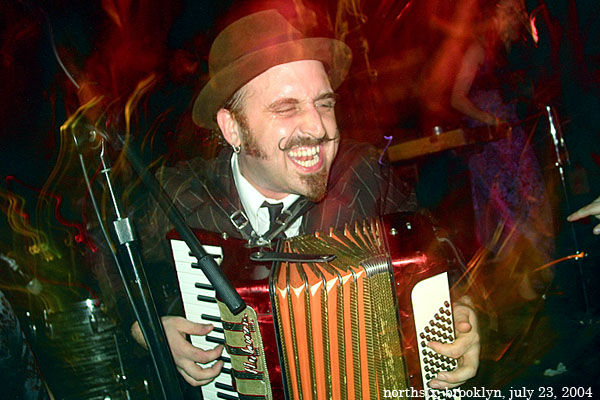
It's hard to overstate what a multi-instrumentalist can do for a sound-- especially in a band with the religious themes of The Hold Steady. If you're going to bring the sermon, you better damn sure bring the organ. But it was more than that. In a world of drums and guitars, it's amazing what an extra sound can do for creating an instant mood within a song. The harmonica for the country, mournful or stomping. A mandolin is a sweetness and a sharpness. Spoons for a goofy, low-rent gait second only to the cowbell. Then, there's the chronically under-utilized accordian. Unfairly banished to polka sideshows in ethnic beerhalls, it's making a slow comeback into coolness. Franz owns three. And you certainly can't discount the value of a good, weird, falsetto high-harmony in the background vocals.

This is not to say that The Hold Steady doesn't or can't exist without Franz, but they do have to fill the gaps. That's maybe the most interesting thing about this album. By leaving because of lack of room to grow, Franz may actually force the band to noticeably evolve, but evolve within the scope of that one "big idea."

"There was that whole weird thing with the horses. I think they know exactly what happened. I don't think it takes any explaining." - "The Weekenders"

Enough about what's missing, let's talk about what's still there. Craig Finn can still turn a phrase, tell a story, give a sermon, bring a simple truth and make absolutley no sense whatsoever. The songs are absolutely there. What Finn does better than anyone else is being constantly self-referential without being reptitive or inaccessible. Each song stands on it's own, but also fits into a larger continuing narrative. The band's past albums aren't prequisities in the way Alegra is to Calculus, but compliments. It adds depth and rewards your curiosity, and it's what makes a thing stand up over time. You can enjoy it in a vaccum, but the more you dig into the context and see it as part of a bigger universe, the more interesting it becomes.

You don't have to have listened to Chips Ahoy! to enjoy The Weekenders. It's a wink to the existing fanbase. "Hey, we know you. Thanks for coming back." And for new fans, it's a future moment of recognition. After they've been through Heaven Is Whenever a few times, they go back and listen to Boys and Girls In America and make the connection. Now, they're on the inside of a joke that was pretty good even from the outside. There are a hundred of those moments throughout the band's catalogue.

"Gonna make like a pre-emptive strike, hit the 5:30 mass every Saturday night." - "Our Whole Lives"

It's the rock show with driving hooks and story songs straight out of Warren Zevon's playbook. Hurricane J is the girl you can't save without changing everything you love about her. We Can Get Together about people who only communicate indirectly through pop culture and music references (sounds familiar). And then the celebrations and consequences of the cycle of self-destruction that are the core of any Hold Steady album so far. Increasingly, the voice is of an older brother trying to give a lesson of experience-- though he slips from the message of warning to remember the good times on a dark road in a way that you know even he hasn't quite decided if it was worth it or not.

Even without Franz, it's still the Steady. It's still among the best rock out there, and nobody else is doing quite the same thing.